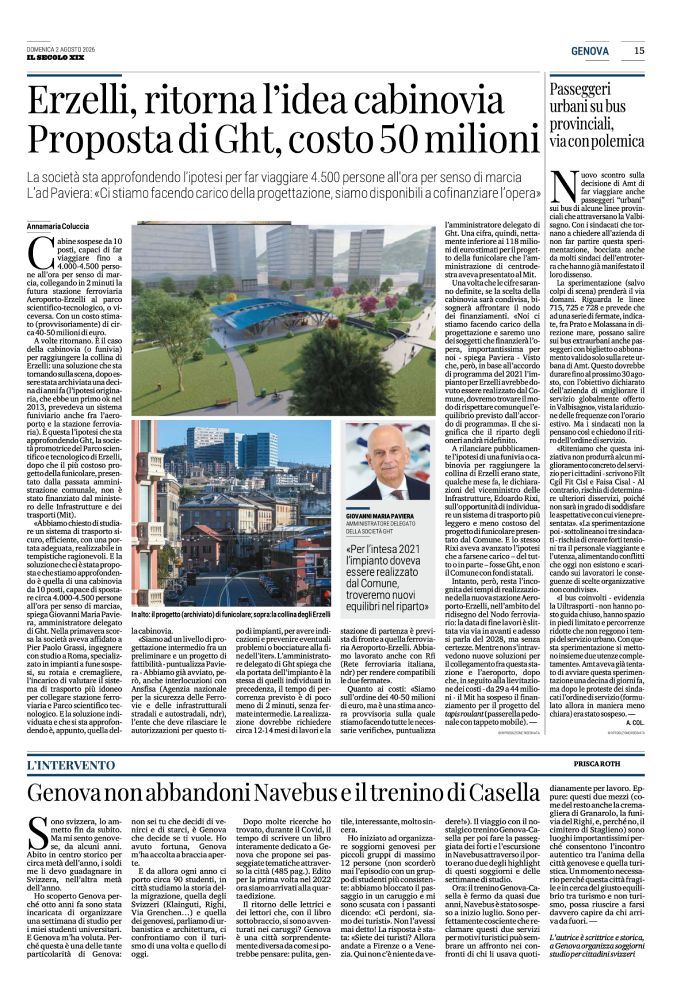
There is one question that has accompanied the Erzelli project from the very beginning: how do you get up the hill? Today, that question has an answer in the design phase.
Last spring, Genova High Tech commissioned Pier Paolo Grassi, an engineer based in Rome who specializes in cable transport systems, railways, and rack railways, to assess the most suitable transport system for connecting the future Airport-Erzelli railway station with the science and technology park. “We asked him to study a transport system that would be safe, efficient, offer adequate capacity, and be feasible within a reasonable timeframe,” explained CEO Giovanni Maria Paviera to Il Secolo XIX.
The proposed solution is a cable car with 10-seat cabins, capable of transporting approximately 4,000–4,500 passengers per hour in each direction. The journey is expected to take just under two minutes, with no intermediate stops. The departure station will be built opposite the Airport-Erzelli railway station. Genova High Tech has also worked with Rete Ferroviaria Italiana, Italy’s national railway infrastructure manager, to ensure that the two stations are compatible, allowing passengers stepping off the train to find the cable car directly in front of them.
The design has reached an intermediate stage between a preliminary design and a feasibility study. Discussions have already begun with ANSFISA, the national agency responsible for issuing the necessary authorizations, to anticipate and prevent potential issues during the approval process. Construction would take approximately 12–14 months. As for costs, the current provisional estimate is between €40 million and €50 million—considerably less than the €118 million projected for a funicular railway previously submitted to the Ministry of Infrastructure and Transport, which did not receive funding.
The most significant issue, however, concerns the division of responsibilities. “We are taking responsibility for the design and will be one of the parties financing the project, which is extremely important to us,” Paviera stated. Under the 2021 program agreement, the transport system serving Erzelli was supposed to be built by the City of Genoa. The allocation of costs will therefore need to be revised, while maintaining the balance established by the agreement. “Under the 2021 agreement, the system was to be built by the City. We will find a new balance in the allocation of responsibilities and costs,” the CEO explained.
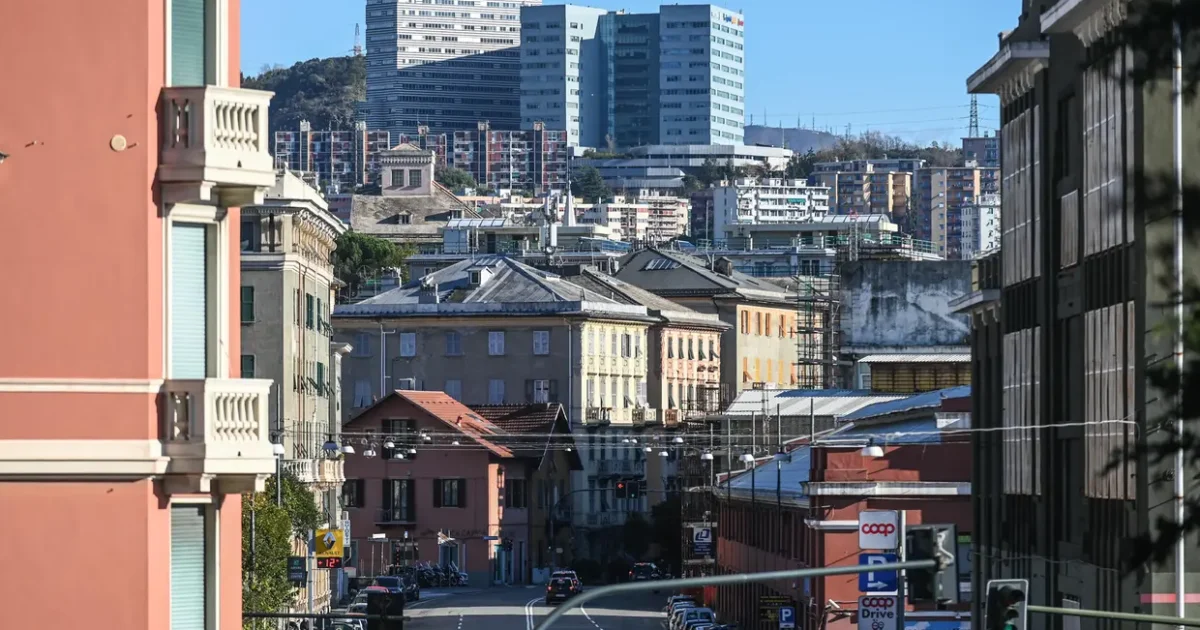
The connection is part of a broader picture that is gradually taking shape: the new Airport-Erzelli railway station, included in the redevelopment of Genoa’s railway junction and currently expected to open in 2028, and a hill where the researchers and thousands of students at the Polytechnic School will join the employees of the twenty technology companies already based there.
For a science and technology park designed to be a thriving, active community, accessibility is not merely a technical detail. It is the condition that allows everything else to work. That is why, this time, the company that developed the hill has decided to take the initiative and address the challenge itself.