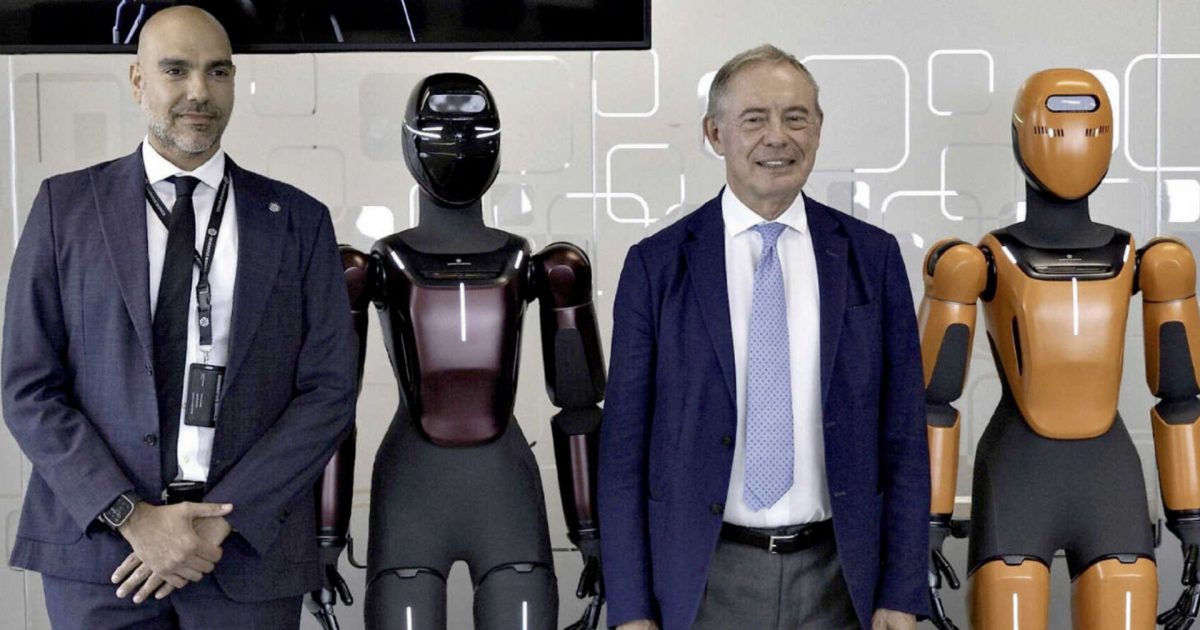
On 21 October, at CES Unveiled Milan, the Milan edition of the Consumer Electronics Show in Las Vegas, Generative Bionics presented its plan for a Physical AI Data Factory: a network of three centres where humanoid robots will be trained before they enter customers’ plants. The first will be in Italy and will cover 5,000 square metres. Work is starting now, with opening scheduled for the fourth quarter of 2027. The other two will be built in a second European country and outside the European Union, to serve global markets. The announcement was made by Daniele Pucci, CEO of the humanoid robotics company headquartered at Erzelli.
The figures give a sense of the project’s scale. Across the three sites, Pucci wrote on LinkedIn, Generative Bionics plans to invest up to $2 billion. The funding round that financed the company’s first steps, closed in December 2025, was worth €70 million.
The problem at the root of it all is data. An AI model that writes text learns from billions of pages that already exist online. A robot that has to work on a factory floor has no equivalent archive: no one has recorded on a large scale how to grip a part, how much force it takes to tighten a bolt, or what to do when a person comes close. On the same stage, Keith Strier, AMD’s vice president for AI markets, put the gap into numbers: today between one and six million hours of this kind of data are available, while training robots properly would require around a billion.
The Data Factory is designed to produce them. The first centre will recreate industrial environments chosen together with partner companies, where fleets of GENE.01 carry out real tasks on a continuous basis. Every movement generates data: images, motion, contact, force, proximity, temperature, interaction with people. Part of it comes from the sensorised skin that covers the robot’s entire body. Each environment is then also rebuilt as a digital twin, a virtual copy in which the same task is repeated in thousands of variations: different layouts, different objects and materials, working conditions and faults that would be impossible to reproduce by hand. The models that pass the tests in simulation go back onto the real robots, and the data from the new trials feeds the next cycle. Pucci describes it as a replica of the world, “physically and digitally”, for training robots before they enter it.
The video in which Generative Bionics presented the Data Factory. Source: Generative Bionics
For a company that wants to use GENE.01, the consequence is practical. The robot is configured and tested on the customer’s specific environment before it gets there: perception, motion control, safety behaviour, task execution. Once installed, the robots keep collecting data that feeds back into subsequent training. In the Data Factory, data is also anonymised and abstracted to build models dedicated to individual sectors. Alongside the computing infrastructure, the company’s robotics, artificial intelligence and data engineering teams will work on the entire process, from raw sensor data to the models installed on the robots.
AMD has been part of the project from the start. It invested in Generative Bionics through AMD Ventures as early as the December 2025 round, its processors are on board GENE.01, and its Helios systems will provide the Data Factory’s computing infrastructure. According to Pucci, it was the partnership that made it possible to set the opening for the end of 2027: it gives early access to components that, with AMD’s production already committed, other companies may have to wait for until 2030.
Then there is the question of control. Robots working in factories, warehouses and shipyards collect information about production processes and about the people around them. For Generative Bionics, that data, the models trained on it and the skills to manage them must be produced and verified in Europe. Pucci puts it this way: with artificial intelligence moving into the real world, digital sovereignty “is becoming physical”, because it depends on the robots’ components and on the data they learn from.
The reason robots need to learn quickly is the same one Pucci pointed to at Fly Me To The Moon: population. By 2050 Italy will lose around a fifth of its working-age population, falling from 37 to 30 million. As Generative Bionics sees it, robots will fill jobs that would otherwise remain vacant.
The Data Factory adds to the industrial agreements of recent months: the alliance with Fincantieri for a welding humanoid in shipyards, and the memorandum of understanding signed with Eni on 30 September, which among other things provides for assessing the use of Eni’s high-performance computing to train GENE.01’s models. The city that will host the first Italian centre has not yet been announced.
Read more: Daniele Pucci at Fly Me To The Moon