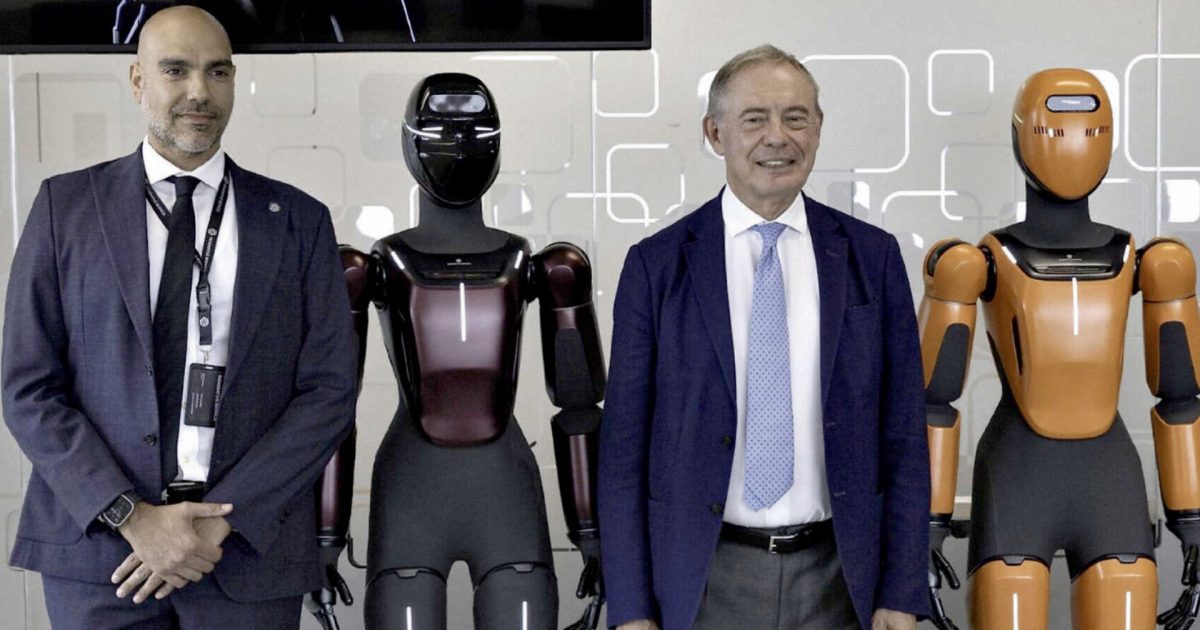
On 6 October, Mundys unveiled the second season of Fly Me To The Moon, a podcast hosted by Riccardo Luna, produced by MoST and recorded at the Fiumicino Airport Innovation Hub. The third episode features Daniele Pucci, CEO of Generative Bionics, the humanoid robotics company based at Erzelli. The episode is available on YouTube, Spotify and Apple Podcasts, as well as on the series page on Corriere della Sera.
Luna opens with a statistic: according to the projections he cites, Italy will have a population of 36 million by 2100. That means fewer nurses in hospitals, fewer workers in factories and fewer people in warehouses. This is the challenge Generative Bionics is seeking to address, and one the interview returns to several times.
Pucci initially came to Genoa for just six months. After completing two PhDs in France, he accepted a temporary position at the Italian Institute of Technology (IIT) while looking for a job in Ireland, where his wife was living. The Irish offer eventually came through, with a salary more than twice as high, but he turned it down. Those six months had convinced him that robotics brought together everything he had studied. In the years that followed, he led iRonCub, the humanoid robot designed to fly using jet engines. It took seven years of testing and three different platforms before it finally lifted off. From 2020 to 2023, he also coordinated ergoCub, an INAIL-funded project aimed at bringing humanoid robots into workplaces to reduce musculoskeletal disorders among workers who handle loads.
The decision to found a company came down to a question of time. In the United States, investors were concentrating enormous amounts of capital in a handful of companies, while in China public support was spread across many. At that pace, Pucci explains, a robot developed in Genoa would become obsolete within three years. If no one brought that research to market, Europe would lose one more alternative.
Starting in Genoa proved to be an advantage, and Pucci illustrates this with a concrete example: when Generative Bionics was founded, 70 people were already working on the same robot design file within a week. He attributes this to the expertise that has built up around IIT. When it comes to funding, however, he acknowledges the gap between the company and its American competitors. Reaching large-scale production, by his estimate, requires half a billion euros, and the €70 million funding round closed in December 2025 covers only part of that amount. What helps narrow the gap is the decade of research already completed: by the time the company was founded, the team had built around 60 robots and had already developed experience in in-house manufacturing and procurement.
When discussing the first product, Pucci reiterates the principle that sets the company apart: a humanoid robot that tries to do everything, he says, “risks doing everything badly”. GENE.01 is a common platform, modular in both hardware and software, from which robots can be developed for five market segments, ranked according to how much work they require from their hands. The first is security and surveillance, where a camera-equipped robot can carry out patrols while the human operator remains at a safe distance. Manufacturing, logistics, retail and healthcare follow.
Luna recalls encountering a small robot at the entrance to a restaurant and being unable to communicate with it. According to Pucci, that machine had not been designed with user acceptance in mind. For Generative Bionics, acceptance requires a robot to be attractive, graceful and safe. The company is working with Italdesign on its appearance. Safety also depends on the sensorized skin covering GENE.01, which originated in IIT technology and has since been redesigned by the company. It allows the robot to detect when someone leans against it. This is why Pucci considers design an integral part of a machine’s intelligence.
The most concrete part of the interview concerns manufacturing. Pucci’s stated goal is to reach a pre-production run of 1,000 robots per month — around 30 a day — in approximately three and a half years, followed by mass production between the fourth and fifth years. The production site will most likely be in Genoa, he says, and the company is currently looking for a location. The reason is practical: the bill of materials for GENE.01 has not yet stabilized across different markets. Until it does, “those who design the robots need to stay close to those who assemble them”. Pucci does not rule out moving part of production elsewhere in the future, but for now the priority is to avoid losing time.
In the final part of the conversation, the focus shifts to Europe. Pucci believes humanoid robotics should be treated as a technological infrastructure for the continent: machines operating in factories, hospitals and homes, collecting data through sensors and cameras, with a supply chain whose key components must remain under control. Europe, he argues, has lost ground by relocating automation manufacturing abroad, losing not only production capacity but also the ability to turn prototypes into products. To regain that capability, he points to two priorities: investing in emerging technologies and building partnerships around Europe’s own strategic needs.
The episode was released one month after Pucci’s interview with theCUBE and one week after the memorandum of understanding with Eni.