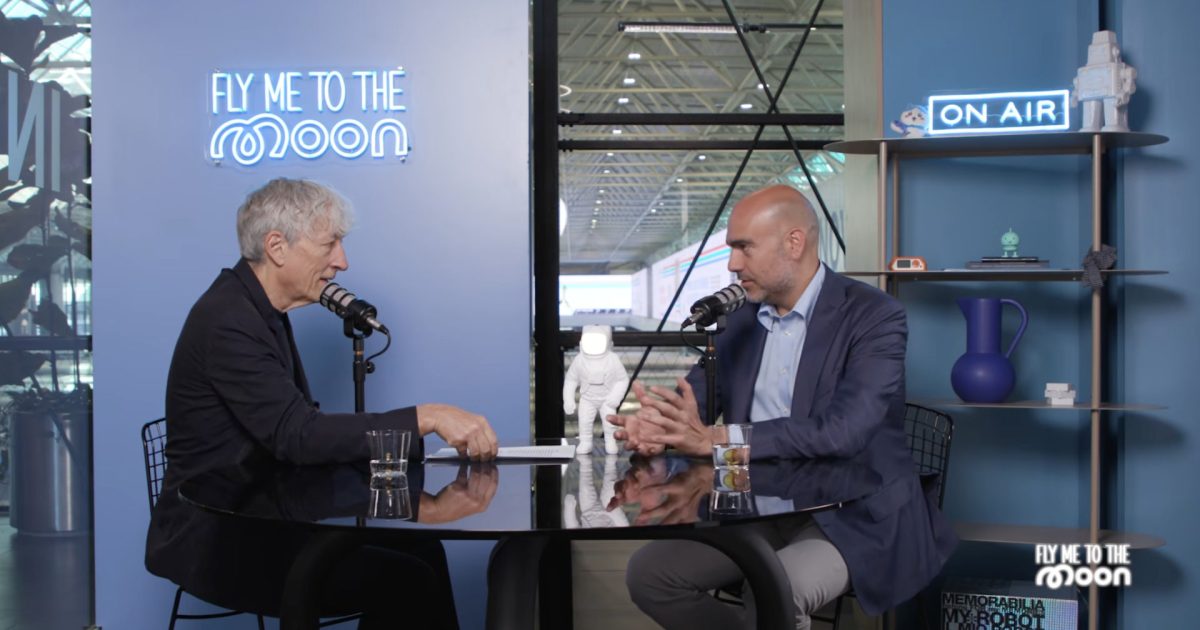
On 23 October, Raising Europe, the podcast in which journalist Tom Guinness interviews founders and investors in European technology, published an episode recorded at Generative Bionics’ headquarters in Genoa. At the table were Daniele Pucci, CEO and co-founder of the humanoid robotics company, and Alessandro Scortecci, Head of Direct Investments at CDP Venture Capital, the fund that backed the company before it even existed and led the €70 million round closed in December 2025.
The Raising Europe episode, in English. The GENE.01 demonstration is at minute 5. Source: Raising Europe
What the investor saw
Pucci described the moment he decided to leave the lab. It was 2022: China was investing heavily in humanoid robotics, he was receiving offers from Chinese companies, and in the United States several researchers were leaving research centres to found companies. Among them was Jerry Pratt, who years earlier had provided his letter of recommendation to IIT and had become CTO of Figure AI. Pucci realised that the technology developed by his group, without a step forward, would become outdated within two or three years. That was the starting point for the technology transfer.
Scortecci explained that CDP Venture Capital funds many spin-offs, but rarely on this scale. Three things convinced the fund: a technical team with fifteen to twenty years of work behind it, and therefore experience rather than just patents; the presence among the founders of an entrepreneur, Davide Scaramuzza, now Executive Chairman; and a focus on industrial applications from day one.
The first step was taken by RoboIT, the technology transfer hub that CDP dedicates to robotics and industrial automation. The fund’s network has six vertical hubs, which finance projects from research centres starting at proof of concept, even before pre-seed investment. With Generative Bionics the path was the same, on a larger scale. Alongside CDP Venture Capital’s AI fund and RoboIT, AMD, Duferco, Eni Next and Tether also took part in the €70 million round. For Scortecci, a robotics company needs industrial investors from the outset: those who know factories help design the product, and those who make processors help size the computing power.
The test of time
Asked what the team had to prove, Scortecci pointed to just one thing: moving from the pace of research to the pace of industrial production. According to his account, the team started from scratch in January and by July had a prototype walking in front of AMD CEO Lisa Su, after four or five complete design cycles in six months.
During the recording, the prototype entered the room. Pucci showed the sensorised skin that covers it, able to sense contact and the proximity of a person, and pointed to it as the capability that will allow humanoids to work alongside people.
One platform, many robots
The company’s name comes from its method. Usually a robot is designed by mechanical engineers and then handed over to those who develop the artificial intelligence: the result, according to Pucci, is often an arm too heavy to lift a box or a weight distribution unsuited to walking. Generative Bionics designs the robot’s body and control together, using generative methods constrained by human biomechanics. For Fincantieri, he explained, it is possible to determine within a few hours the most suitable material and weight distribution for working in a shipyard.
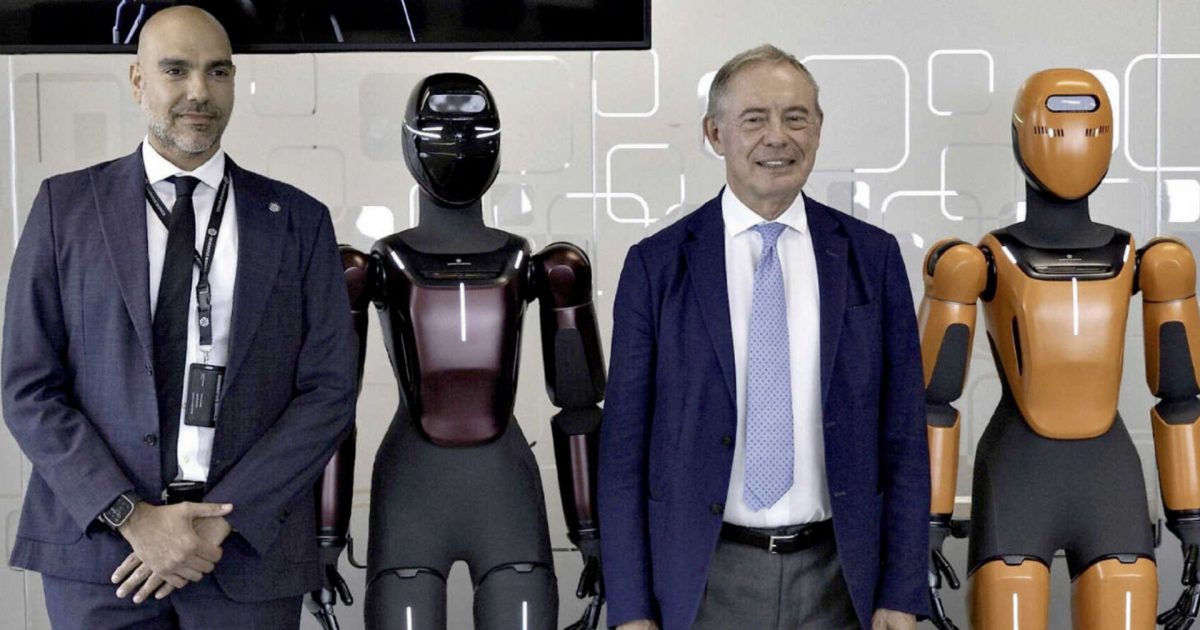
GENE.01 is a modular platform from which different robots are developed for different jobs. During the episode, the base model was joined by the welding version developed for Fincantieri, which already looks different on the outside too. For Scortecci, that is precisely the next step: getting the robot welding inside a ship’s hull in the coming months. After shipbuilding, the company is looking at three sectors: surveillance, logistics and manufacturing, and healthcare.
There is also a supply chain issue. Pucci explained that a robotics company produces three things (robots, artificial intelligence models and data) and that each has its own supply chain. Not everything can be controlled in Europe. In his view, Italy must hold on to two pieces: the origin and training of data, and the safety certification of robots. “We must not see humanoid robots as a product: they are continental technological infrastructure,” he said.
The people and the factory
Today, four in ten people at Generative Bionics hold a PhD, and the average age is 36. Around one in five works in operational functions (HR, finance, health and safety), one in ten in business development and marketing, and the rest in mechatronics and artificial intelligence. The company expects to reach around 130 people in January 2027 and around 200 by the end of the same year, growing mainly on the commercial and operations side: after-sales support, maintenance and control centres for installed robots.
Alongside the Data Factory announced on 21 October, Pucci confirmed plans for a humanoid factory, which the company intends to build itself. A humanoid robot, he said, sits somewhere between a phone, a car and a washing machine, and the way to produce it has yet to be invented: that is why Generative Bionics wants to keep production in-house.
The missing capital
The last part of the episode is about money. According to Scortecci, Italy has around €1 trillion of investable institutional capital, between insurance companies and pension funds, and over the past five or six years around €250 million of it has gone to Italian venture capital. In his view, the problem for European startups is not a lack of ambition: what is missing is capital at the stage when a company needs to scale. Pucci confirmed that further capital will be needed for the next steps, including for the computing infrastructure used to train the models.
In the closing questions, Guinness asked each of them for one request to European governments. Scortecci: buy from European startups. Pucci: write the rules for the new generation of robots together.
Also read: Generative Bionics to Build Its First Data Factory in Italy →