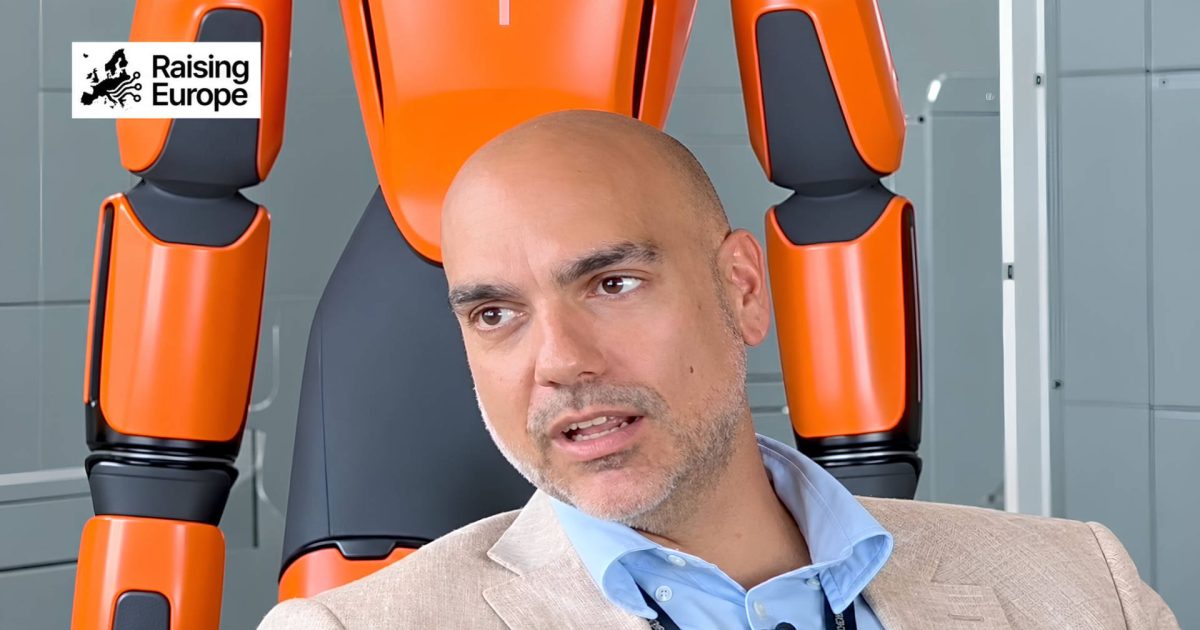
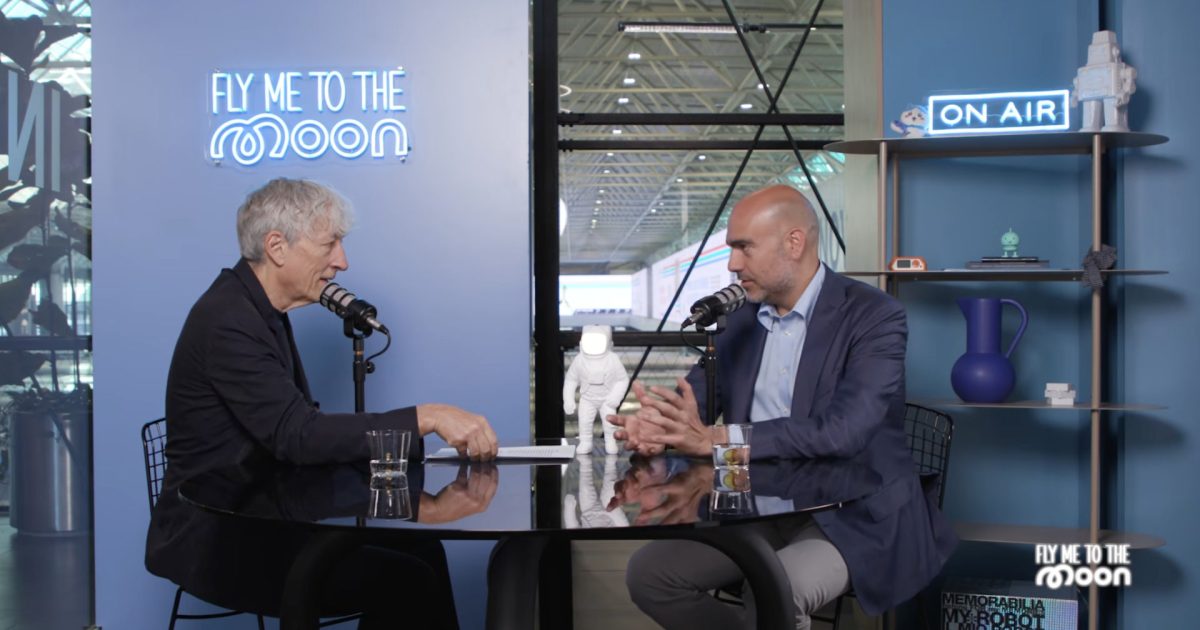
On 30 October, Raising Europe-the podcast in which Tom Guinness interviews people building technology companies in Europe-published an episode featuring Giorgio Metta, Scientific Director of the Italian Institute of Technology. The interview is in English, runs for 52 minutes and was recorded in Genoa. It explores how a laboratory discovery becomes a company, with Metta returning most often to the example of Generative Bionics, the humanoid robotics company headquartered at Erzelli.
Metta is a roboticist. In the early 2000s, he led the development of iCub, the humanoid robot created through a major project funded by the European Commission. It took approximately three years to complete the robot. Today, iCub is 20 years old, and Metta believes the platform needs to be rethought. The team working on it took two different paths. Some researchers remained in the laboratory to study more flexible joints, new ways of moving the robot and interaction with people. Others left and founded a company building large, powerful humanoid robots: Generative Bionics.
Guinness asks him whether working in Genoa had any disadvantages. Metta says no: the technology was available, talented people could be found both in the city and elsewhere, and everything needed for research could be obtained without difficulty. The situation changes when it comes to large-scale production, which the Italian Institute of Technology does not undertake. The components are available, however, and the expertise needed to design electronics and mechanical systems is present. Metta therefore sees the possibility of building humanoid robots here in the future. This is the same direction indicated by Daniele Pucci in early October, when he said that Generative Bionics’ production site would most likely be in Genoa.
A significant part of the interview focuses on researchers becoming entrepreneurs. Metta says that one in two of his former students tells him they are launching a startup, and that half of the research leaders at the Italian Institute of Technology have already founded one. Three, four or five new companies emerge each year, all based on research carried out within the institute. He attributes this to a cultural shift: there are more examples of successful entrepreneurs, and universities and research centres have stopped presenting scientific and business careers as two mutually exclusive paths. It also helps that starting a company costs relatively little in the beginning.
As for how the institute supports people setting out on their own, Metta describes a process without a fixed formula. Some members of the institute’s staff speak with researchers when an idea emerges, review the patents, help determine whether a business model exists, and connect them with venture capital funds and, when needed, with a CEO. There are also accelerator programmes run with business schools, including Bocconi. Then there is the solution Metta considers the most promising: an experienced entrepreneur who devotes their full time to a single project. “That was the case with Generative Bionics,” he says. The first step must be handled properly, with the right funding and enough time to focus on the product. Among the partners he mentions CDP, whose sector-specific funds can finance both a proof of concept and a larger project. The €70 million funding round closed by Generative Bionics in December 2025 was led by CDP Venture Capital’s artificial intelligence fund.
Metta asks investors to be patient. Truly new technology changes the way things are done and encounters resistance: it took the personal computer 35 to 40 years to become a mass-market product. For robots, the process takes even longer because they are hardware. As he explains, general-purpose humanoid robots still lack artificial intelligence trained with an understanding that they have a body, reliable tactile sensors, and the ability to grasp and use arbitrary objects. For this reason, he suggests starting with specific applications in sectors where companies can already generate revenue. Generative Bionics has taken this approach with GENE.01: a common platform from which robots for five market segments can be developed, beginning with surveillance and security.
The topic Metta emphasises most is talent. The best people, he says, cannot be retained through salary alone: they go where the laboratories and equipment allow them to do something interesting. He gives the example of CERN, which has attracted researchers from around the world thanks to its infrastructure, as well as an example from his experience at the Italian Institute of Technology. When the institute acquired a state-of-the-art microscope, researchers came from abroad and some Italian researchers returned home. Europe has quality of life on its side, he adds, but first it needs the places where outstanding work can be done.
Asked what he would change about Europe if he had a magic wand, Metta points to its attitude towards risk: a society that protects people who try to do something new instead of criticising them if they fail. His advice to young researchers follows the same direction. Believe in your idea and, if you lack the intuition needed to develop a business model, find a friend who has already become an entrepreneur.
The episode is available on YouTube and Spotify. Generative Bionics’ own account of the company’s development can be found in Daniele Pucci’s interview with Fly Me To The Moon and in the article about the agreement with Eni.
Read also: Daniele Pucci on Fly Me To The Moon →